Run Microsoft Like a Business: The Strategic Guide to Microsoft Optimization Assessments
For most US mid-market organizations with 250 to 5,000 employees, Microsoft is the largest recurring line item in the IT budget. Yet, it is often treated like a utility—a monthly bill that arrives, gets paid, and grows quietly in the background.
In the current economic climate, “quiet growth” in your Azure and M365 spend is a symptom of operational debt. Treating Microsoft like a utility instead of a business asset leads to cost creep and governance gaps.
To regain control, leadership needs more than a license provider; they need a strategic Microsoft Optimization Assessment.
The Hidden Cost of Under-Managing the Microsoft Ecosystem
Most organizations don’t actually overspend on Microsoft; they under-manage it.
When an organization scales, the complexity of licensing tiers and Azure resource allocation surpasses the capabilities of traditional IT management.
This is where Microsoft Optimization Assessments become essential for the C-Suite.
Addressing the Three Pillars of Operational Debt
- Azure Cost Creep: Without structured Azure FinOps ownership, cloud environments expand without oversight. Budgets lose predictability, and waste becomes a permanent fixture in the balance sheet.
- Licensing Redundancy: Paying for E5 features that are never deployed or maintaining licenses for dormant accounts is direct capital leakage.
- Governance and Security Drift: Security tools are often deployed but rarely governed. As policies drift, compliance weakens, and audit defensibility erodes.
A comprehensive Microsoft Optimization Assessment is designed to identify these specific leakages, providing a data-driven roadmap to recover capital and secure the environment before the next renewal cycle.
How to Run Microsoft Like a Business (Not a Utility)
Running Microsoft “like a business” means moving beyond transactional support toward operational discipline.
It requires a shift from reactive renewals to proactive governance. By utilizing Microsoft Optimization Assessments, CFOs and CIOs can transform their IT stack from a cost center into a lean, secure asset.
The Shift to Operational Discipline
At the mid-market level, the goal of an assessment isn’t just to find “discounts.” It is to establish defined accountability and governance workflows.
This ensures that every dollar spent on Microsoft cloud services is mapped to a specific, measurable business outcome.
Moving Beyond the Transactional CSP Model
Traditional Cloud Solution Providers (CSPs) focus on the transaction—selling the seat. An operational partner focuses on continuous management through Microsoft Optimization Assessments. This includes:
- Ongoing Azure cost governance and FinOps oversight.
- Continuous security posture management across the M365 tenant.
- Utilization intelligence that informs high-stakes contract negotiations.
What is Included in a Funded Microsoft Optimization Assessment?
Many C-level executives are unaware that these deep-dive reviews are often fully funded by Microsoft through the Microsoft Commerce Incentive (MCI) program.
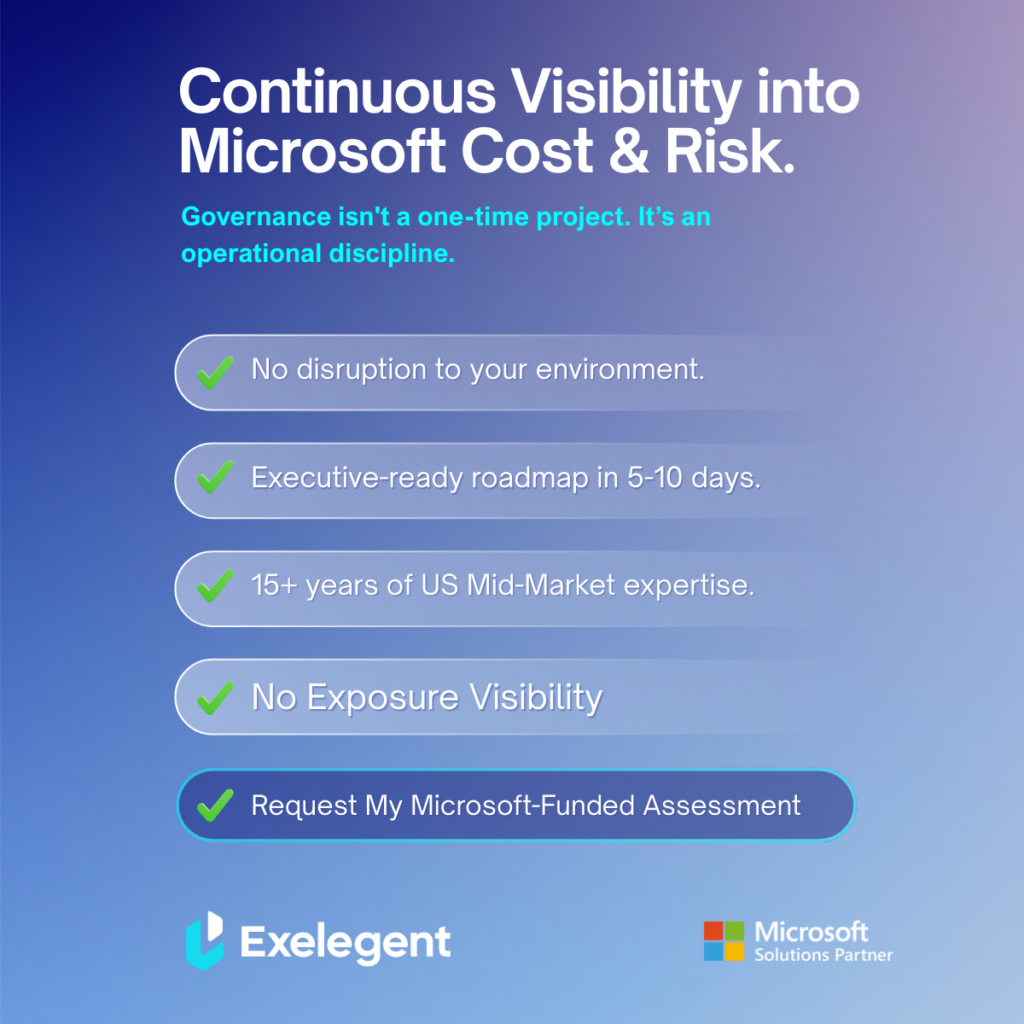
This allows eligible US businesses to receive an executive-ready roadmap worth up to $26,000 at zero cost.
The Core Components of the Microsoft Optimization Process
- Azure Cost Governance Review: A deep analysis of resource utilization to eliminate waste and optimize reserved instances (RI) and savings plans.
- Licensing & Utilization Intelligence: Mapping seat counts to actual usage to identify over-provisioning and redundant premium add-ons.
- Security & Compliance Audit: A non-intrusive review of your environment against frameworks like NIST, SOC2, or HIPAA to identify misconfigurations.
- Executive-Ready Roadmap: A strategic priority list delivered in 5-10 days, built specifically for leadership review and board-level presentations.
Non-Intrusive Execution
A common concern for CIOs is disruption. Modern Microsoft Optimization Assessments use read-only telemetry collectors. This allows for deep insights into cost and risk without impacting system performance or user experience.

Strategic Outcomes: What a CIO Should Expect in 30 Days
The primary objective of Microsoft Optimization Assessments is to move from raw data to decision-ready insights. Within a 30-day window, a mid-market enterprise should achieve:
- Predictability: Clear visibility into upcoming licensing true-ups and Azure growth trends.
- Capital Recovery: Identification of immediate savings—often exceeding $100,000 for firms with over 500 users.
- Risk Quantification: A unified score reflecting your operational, financial, and security exposure.
Why Mid-Market Leaders Are Prioritizing Optimization
In a landscape where IT budgets are under intense scrutiny, Microsoft Optimization Assessments offer a “low-hanging fruit” opportunity for CFOs to improve the bottom line without cutting headcount or vital services.
By identifying “Shadow IT” and unused subscriptions, companies can reallocate that budget toward higher-value initiatives, such as AI integration or infrastructure modernization.
Furthermore, the assessment ensures that the organization is not “over-insured” or “under-protected” by aligning the licensing tier precisely with the security requirements of the business.
FAQ: Navigating Microsoft Strategy and Funding
Is the Microsoft Optimization Assessment really fully funded?
Yes. Microsoft funds these engagements for qualified organizations (typically 250+ seats) to ensure ecosystem health and security.
This is a strategic investment by Microsoft to help you maximize the value of their platform and ensure long-term stability.
Do we need to change our current Microsoft partner or CSP?
No immediate change is required to receive the assessment and roadmap.
The goal is transparency. However, to implement a model of continuous optimization, many enterprises choose to align with a partner that offers structured ownership and advanced cyber risk management platforms.
Who should be involved in the assessment process?
For a successful outcome, we recommend involving the CFO or VP of Finance for the financial roadmap and the CIO/IT Director for the strategic and technical alignment. This ensures that the findings are actionable across both the finance and technology departments.
Your Microsoft Environment is Too Critical to Operate Reactively
Stop waiting for your next renewal surprise to discover your operational gaps. Your Microsoft environment is the backbone of your company’s productivity and security; it deserves a disciplined, business-first approach.
By leveraging a funded Microsoft Optimization Assessment, you gain the clarity, cost control, and governance confidence needed to turn your IT stack into a competitive advantage.